1kWh / PRODUCT RESEARCH
Anker SOLIX C1000 Gen 2 Review: A Strong 1kWh Pick for Portable Power
1,024Wh, 2,000W output and a 24.9 lb chassis — the useful question is whether roughly 1kWh is the right energy class for your setup.
Affiliate disclosure: WattPick Lab may earn a commission from qualifying purchases through affiliate links, at no additional cost to you. Editorial conclusions are independent of commissions. How our links work.
The Anker SOLIX C1000 Gen 2 sits in one of the most competitive parts of the portable power station market: around 1kWh.
Its formula is straightforward — 1,024Wh of capacity, 2,000W AC output and a 24.9 lb chassis — but those numbers make it relevant to a wide range of buyers, from car campers to households looking for a compact source of outage power.
The important question is not whether the C1000 Gen 2 has enough features.
It is whether roughly 1kWh is the right energy class for your setup.
QUICK VERDICT
Buy it for the 1kWh class, not for growth.
The C1000 Gen 2 is the most portable way into Anker’s line with real appliance headroom: 2,000W of output and 24.9 lb is an unusually useful combination in this class.
IS THIS THE RIGHT ONE?
Anker SOLIX C1000 Gen 2: who it fits, and who it does not
Best for
- You want enough output to run substantial appliances without moving to a 2–4kWh system
- You expect to carry the station between a house, a vehicle and a campsite
- 1,024Wh matches what you actually use between recharges
Look elsewhere if
- Your estimated daily consumption is already near or above 1kWh
- Expandable battery capacity matters to you
- You are planning around large household or 240V loads
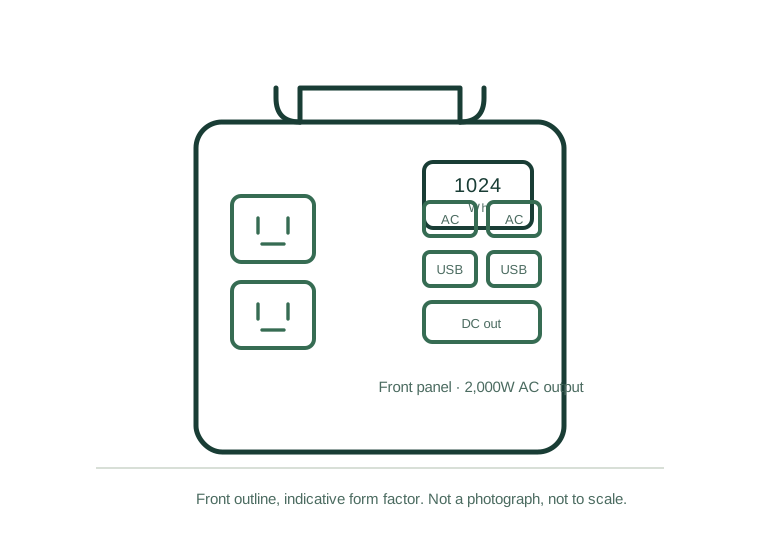
Key specs: what Anker publishes — view the full specification table
| Specification | Published value |
|---|---|
| Battery capacity | 1,024Wh |
| Rated AC output | 2,000W |
| Peak output | 3,000W |
| Weight | 24.9 lb |
| Dimensions | 15.12 × 8.19 × 9.61 in |
| Maximum solar input | 600W |
| UltraFast AC input | 1,600W |
| UPS switchover | 10 ms |
| Expandable capacity | No |
These are manufacturer specifications rather than WattPickLab laboratory measurements. Confirm the current regional manual and warranty terms before buying.
1. Portability is one of its strongest arguments
Anker lists 24.9 lb. That makes regular house-to-vehicle movement more plausible than with larger systems, but it is not a backpacking battery. Include panels, cables and terrain when comparing complete-kit weight.
2. 2,000W output gives it broad appliance coverage
The 2,000W continuous rating and 3,000W peak figure serve different purposes. Add simultaneous loads and check startup requirements rather than selecting from appliance names alone. Nominal 1,024Wh limits duration: with an illustrative overall 80% usable factor and 10% reserve, about 737Wh remains, roughly 7.4 hours at 100W average demand. This is not a test result.
3. Fast recharging is useful when turnaround time matters
Anker specifies up to 1,600W UltraFast AC charging and advertises roughly 49 minutes to full under its stated conditions. Confirm the mode and supply required. Solar input is limited to 600W; choose a compatible array and estimate realistic daily yield rather than assuming panel nameplate output all day.
4. The biggest trade-off is expansion
The C1000 Gen 2 does not support an expansion battery. Buy it when your energy budget fits the fixed 1,024Wh class and a dependable recharge plan. If growth beyond 1kWh is central, compare a documented expandable platform before ordering.
Alternatives worth comparing
Explorer 1000 v2
Lighter, different trade-offs.
Read review →DELTA 3 Plus
Charging and solar alternative.
Compare →Elite 100 V2
Another 1kWh finalist.
Compare →FINAL VERDICT
A strong 1kWh pick, if 1kWh is the right class.
The C1000 Gen 2 makes the strongest case when you want a mainstream 1kWh power station that remains genuinely portable. Its 2,000W AC output gives it broad appliance flexibility, while the 24.9 lb weight keeps it much easier to move than larger backup-focused systems. Fast AC charging and 600W maximum solar input further strengthen its fit for travel and intermittent off-grid use.
Research basis
Sources & methodology
Sources checked September 30, 2026. This article covers the original US C1000 Gen 2. We distinguish Anker’s claims from our own calculations and assumptions.
- Anker SOLIX C1000 Gen 2 product page ↗ — manufacturer specifications used throughout this review.
- WattPick Lab: Best Anker SOLIX power stations ↗ — cross-model comparison and the ladder this review is placed on.
- WattPick Lab editorial standards ↗ — how we separate published specifications from our own labelled calculations.
Specifications and product availability can change; verify current configuration and compatibility before purchasing. Anker’s 49-minute recharge and 1.8-hour solar figures are manufacturer claims made under stated maximum-input conditions.
Deciding between two 1kWh stations?
The C1000 Gen 2 is the output-forward option in this class. See how it measures against the other 1kWh finalists.