Frizzlife M800-new Review: 900 GPD RO Without an Electrical Outlet
Affiliate disclosure: We may earn a commission when you buy through these links, at no additional cost to you. How our links work.
Quick verdict
The M800-new stands out for non-electric RO production rather than its headline capacity. Frizzlife publishes up to 900 GPD and a dynamic up-to-4:1 pure-to-drain ratio. The design relies on household feed-water pressure instead of a conventional electric booster pump.
Best fit: a suitable pressure supply, enough cabinet height and a preference for an integrated remineralization route without an RO-production outlet. Skip it: when feed pressure is questionable, the tall unit does not fit, or you need a countertop machine.
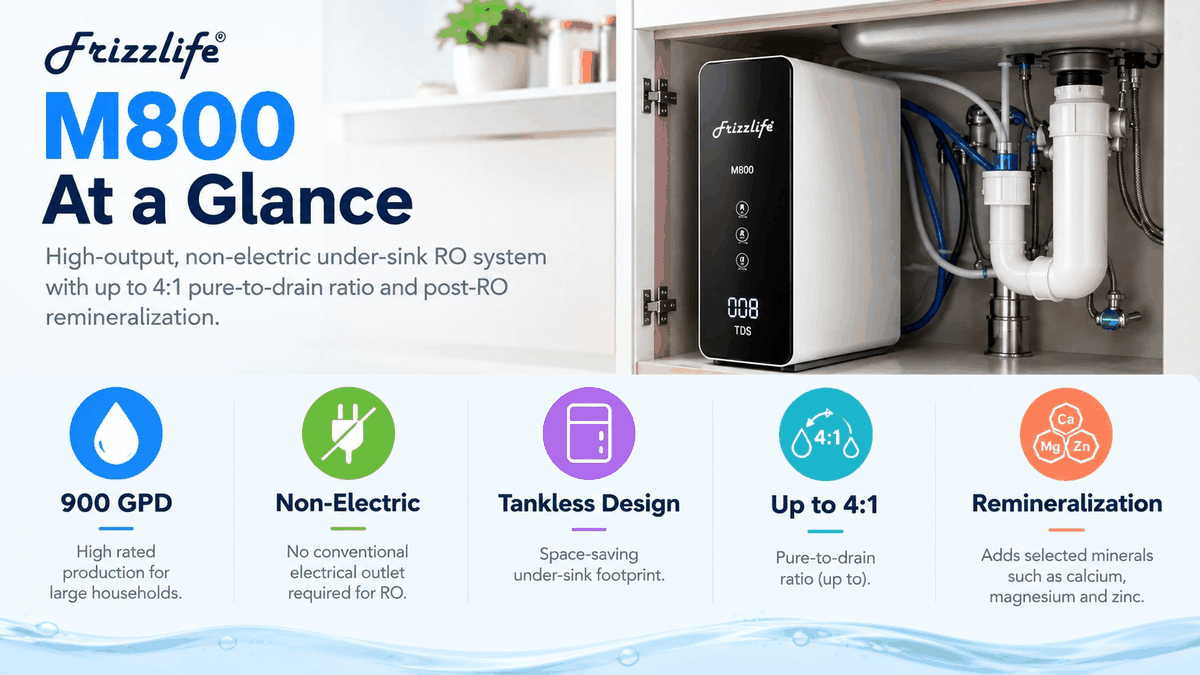
Key specs: what Frizzlife publishes — view the full specification table
| Specification | Published figure | What it actually tells you |
|---|---|---|
| Configuration | Under-sink, tankless | Produces on demand; no pressure tank to place or run dry. |
| Rated production | Up to 900 GPD | Manufacturer-rated daily production under stated conditions; tap flow varies with installation and water conditions. |
| Electricity for RO production | No conventional connection required | Feed-water pressure does the work, so pressure matters more. |
| Pure-to-drain | Up to 4:1 | A rated efficiency figure, not a guaranteed recovery. |
| Remineralization | Yes, after RO | Frizzlife names calcium, magnesium and zinc among the added minerals. |
| Monitoring | TDS / filter-life display | Reads after remineralization, so the number includes added minerals. |
| Flush system | Auto flush | Rinse behaviour is handled by the unit, not by a manual routine. |
| Published dimensions | Approx. 14.5 × 5.1 × 19.7 in | Frizzlife’s own pages also show 14.9 × 5.5 × 19.7 in — plan for the larger. |
| Installation | Under-sink | Still needs a feed-water connection and a drain route. |
| Best fit | High output without a nearby outlet | The combination, not any single figure, is the selling point. |
GPD = gallons per day. Rated figures are published at manufacturer test conditions, and cold or low-pressure supply water reduces real output.
Pressure and height come first
Check the pressure requirements in the current manual for the exact M800-new variant. A non-electric design cannot be chosen solely from the GPD rating when the supply pressure is weak or inconsistent. A different architecture may be more suitable, but a pump-equipped alternative still needs a compatible feed supply.
Frizzlife’s material gives both 14.5 × 5.1 × 19.7 in and 14.9 × 5.5 × 19.7 in. Plan around the larger published envelope and confirm the supplied model. Leave clearance for the sink basin, tubing, cartridges and access. Cold-water and drain connections are still required.
Understand the two “up to” ratings
Frizzlife rates the M800-new at up to 900 GPD daily production and publishes a dynamic pure-to-drain ratio of up to 4:1 under suitable conditions: as much as four parts purified water for one part reject water. Both depend on the water and installation conditions.
Use those figures to compare the manufacturer’s published designs; do not convert them into guaranteed household delivery. A tall cabinet and adequate pressure can matter more than the difference between 600 and 900 GPD.
Minerals and model-specific evidence
The M800-new adds remineralization after RO in an integrated treatment route. Post-RO mineral addition can raise final-water TDS compared with water leaving the membrane, so the final reading alone is not a contaminant-removal test.
Frizzlife’s certification displays vary across M800-series variants. Verify the sheet for the actual model and named contaminant; do not combine the series into one blanket certification claim or choose from an “8-stage” label.
Check replacements before committing
Confirm each compatible replacement cartridge, its current price and the model’s replacement instructions. A higher rated production figure does not tell you annual ownership cost or local filter availability. Water quality and use can bring nominal changes forward.
Inspect the installation drawing for cartridge-removal space and access to the shutoff. If the unit just fits under the basin but cannot be serviced, the advertised narrow body has not solved your cabinet problem.
M800-new or PD600-TAM3?
The full comparison separates the two architectures. M800-new offers integrated remineralization and non-electric production, conditional on feed pressure. PD600-TAM3 is a powered 600 GPD system with a separate TAM3 module and a published 2:1 ratio.
The PD600-TAM3 has two housings to fit and a documented three-cartridge schedule. Decide between them from supply conditions, usable cabinet space and replacement needs. If permanent plumbing is the obstacle, use the countertop branch of the RO guide.
The buying decision
Shortlist M800-new after verifying feed pressure, the larger published dimensions and compatible replacements. The non-electric architecture is a meaningful distinction when it fits your installation; the 900 GPD headline is not a substitute for those checks.
Sources & editorial method
This review uses manufacturer documentation, certification records where available, and product specifications. Performance can vary with installation and operating conditions. Runtime and cost examples are labelled planning calculations. Check the exact US model, current documentation and seller configuration before ordering.