COMPARISON / UNDER-SINK RO / US MODELS
Frizzlife M800 vs PD600-TAM3: Which RO System Should You Buy?
Two tankless under-sink RO systems, two architectures: up to 900 GPD non-electric production against a powered 600 GPD platform with a separate TAM3 module.
Affiliate disclosure: WattPick Lab may earn a commission from qualifying purchases made through links on this page, at no additional cost to you. Editorial conclusions are independent of commissions. How our links work.
QUICK ANSWER
A non-electric 900 GPD design, or a powered 600 GPD modular setup?
The Frizzlife M800-new and PD600-TAM3 are both tankless under-sink RO systems with remineralization, but they solve the problem differently. The M800-new prioritizes non-electric operation, higher rated production and a stronger published pure-to-drain ratio; the PD600-TAM3 uses a powered RO platform with a separate TAM3 remineralization module. [1] [2]
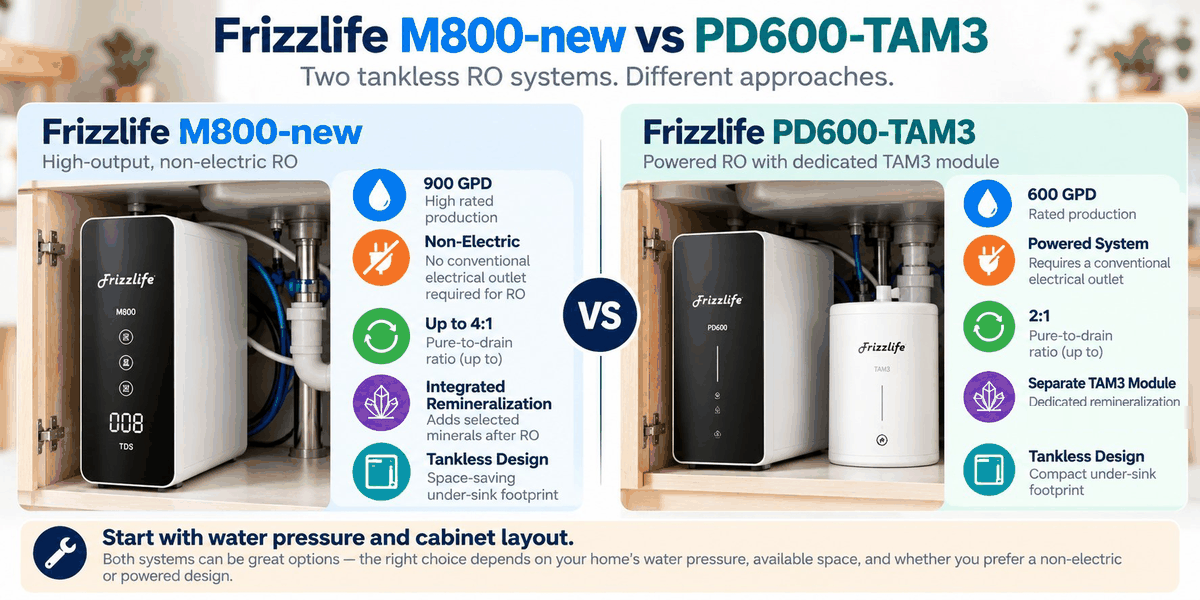
M800 vs PD600-TAM3: Key Differences
Published figures from Frizzlife’s product pages; each difference that changes what you buy gets its own section below. [1] [2]
| Frizzlife M800-new | Frizzlife PD600-TAM3 | |
|---|---|---|
| Type | Tankless under-sink RO | Tankless under-sink RO |
| Rated production | Up to 900 GPD | 600 GPD |
| Electricity for RO production | No conventional connection required | Powered system |
| Pure-to-drain ratio | Up to 4:1 | 2:1 |
| Remineralization | Integrated post-RO route | Separate TAM3 module |
| Main system dimensions* | Approx. 14.9 × 5.5 × 19.7 in | PD600: 5.3 × 14.7 × 15.5 in |
| Additional module | — | TAM3: 5 × 5 × 13.5 in |
| Best fit | High rated output without a nearby outlet | Powered modular RO setup |
*Manufacturer-published dimensions — check current documentation before installation.
Choose the M800-new if You Don’t Want to Depend on an Outlet
M800-new relies on feed-water pressure rather than a conventional electric booster pump for RO production. Choose it only after checking the current manual’s pressure requirements. Its up-to-900-GPD and up-to-4:1 figures are conditional, not guaranteed faucet output or recovery.
PD600-TAM3 is a powered 600 GPD system with a 2:1 listing. A pump-equipped design does not remove the need for a compatible feed supply. Decide from the actual installation, not from headline GPD alone.
Remineralization: Same Goal, Different Layout
Both routes add minerals after RO. M800-new integrates that treatment; PD600-TAM3 uses a separate TAM3 module. The difference is cabinet layout and replacement needs, not proof that one produces universally “better” water. Verify the exact variant’s contaminant claims and cartridges.
Which One Fits Better Under the Sink?
Frizzlife lists the M800-new at approximately 14.9 × 5.5 × 19.7 in; the same site’s comparison material also shows 14.5 × 5.1 × 19.7 in — where two published dimension sets exist, plan for the larger. [2] The PD600 is approximately 5.3 × 14.7 × 15.5 in, plus a separate TAM3 module of about 5 × 5 × 13.5 in.
The M800 is taller; the PD600-TAM3 is two components. Measure around the real obstacles — sink basin, disposal, drain plumbing, shutoff valves, filter-service clearance. M800: watch vertical clearance. PD600-TAM3: allow room for both housings.
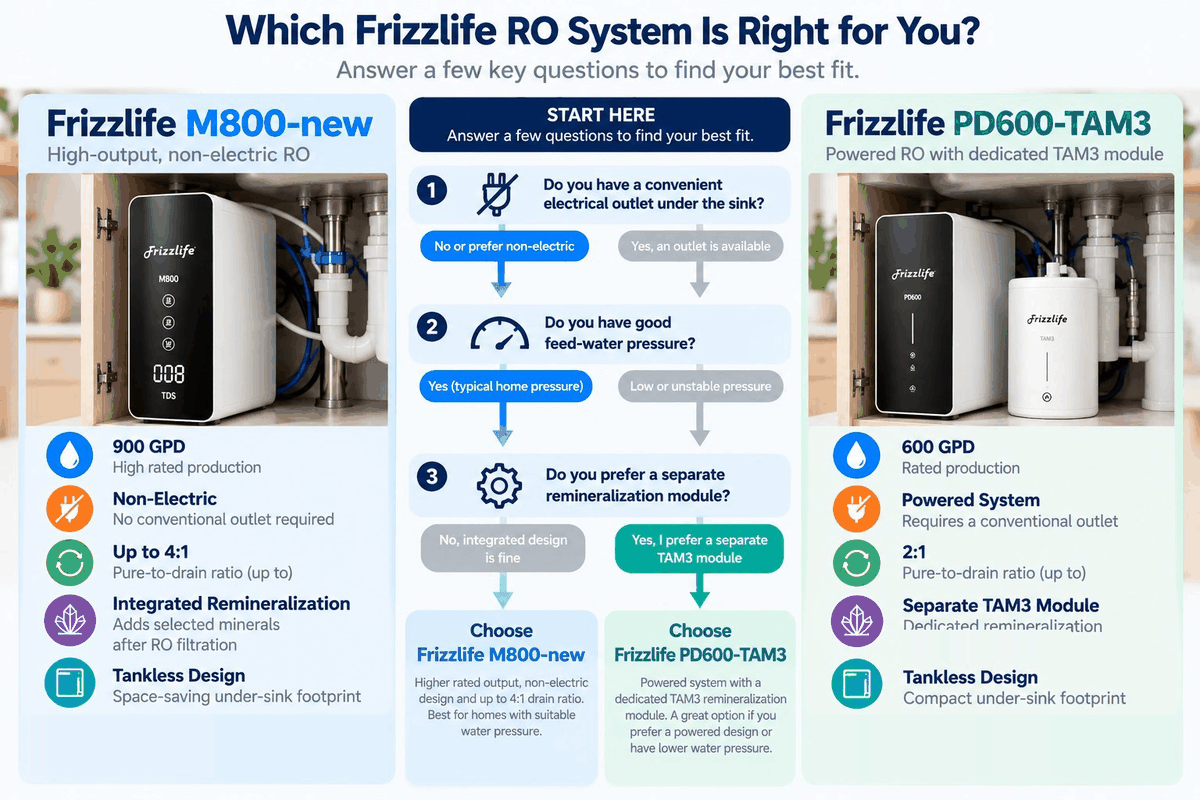
FINAL DECISION
For a suitable installation, start with the M800-new.
Up to 900 GPD, non-electric RO production and an up-to-4:1 published pure-to-drain ratio give the M800-new the stronger specification package — but it is not automatically the better choice for every home.
Research Basis
This comparison uses US manufacturer documentation and product specifications. Performance can vary with installation and operating conditions. Dimensions conflict within M800-series material, so plan for the larger published envelope and confirm the supplied model. Certification displays vary across variants; check the exact performance sheet.