COMPARISON / UNDER-SINK RO / US MODELS
Waterdrop G3P800 vs Frizzlife PD600-TAM3: Which Tankless RO Fits Your Kitchen?
Both are tankless under-sink systems that need a cabinet, a drain and an outlet. Waterdrop spends the difference on output, a lower waste ratio and a UV stage; Frizzlife spends it on putting minerals back after the membrane.
Affiliate disclosure: WattPick Lab may earn a commission from qualifying purchases made through links on this page, at no additional cost to you. Editorial conclusions are independent of commissions. How our links work.
30-SECOND ANSWER
More water and less waste, or minerals added back?
Neither system is simply the better one. Both are tankless under-sink units that need an outlet, and both list the same 0.0001 µm nominal membrane rating. What differs is output, the pure-to-drain ratio, the stage after the membrane and the cartridge bill. [1] [2]
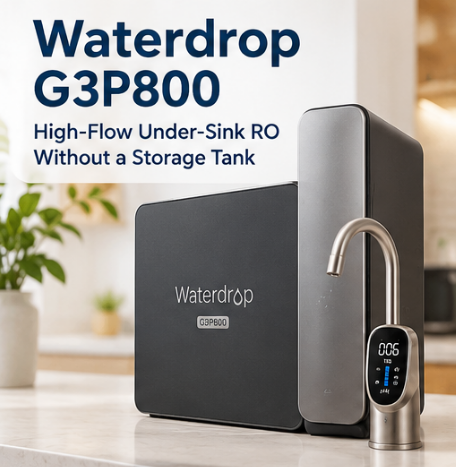
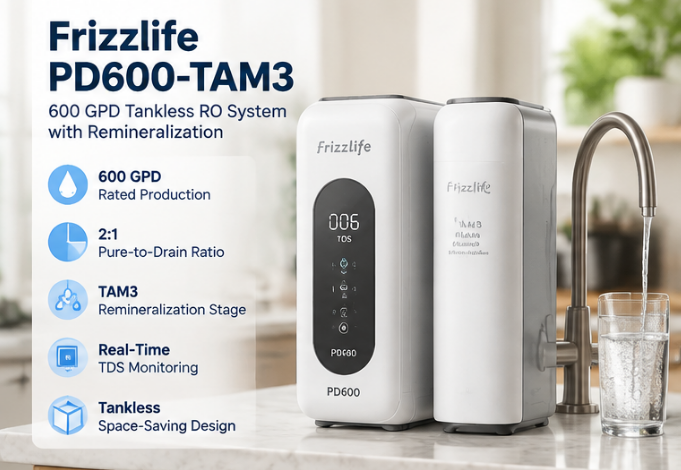
Key differences at a glance
Published figures from both manufacturers. Where a difference changes what you buy, it gets its own section below.
| Specification | Waterdrop G3P800 | Frizzlife PD600-TAM3 |
|---|---|---|
| Configuration | Under-sink, tankless | Under-sink, tankless, plus TAM3 |
| Rated output | 800 GPD | 600 GPD, approx. 0.41 GPM |
| Pure-to-drain | 3:1 advertised | 2:1 listed |
| RO membrane | 0.0001 µm nominal | 0.0001 µm nominal |
| After the membrane | UV stage, equipped configuration | TAM3 remineralization module |
| Certification | IAPMO R&T to NSF/ANSI 42, 53, 58 and 372 | SGS-tested to NSF/ANSI 42, 53 and 58, plus 372 |
| Filter indicator | Smart faucet, TDS and filter life | Real-time outlet TDS |
| Cartridges | Three: composite, carbon block, RO membrane | Three: ASR211, FZ-4, ASR212-600G |
| Nominal intervals | Up to 6, 12 and 24 months | 12, 12 and 24 months |
| Footprint | One unit, one faucet | Two housings |
Sources: both manufacturers’ published product information for the US models, listed under Sources & editorial method. A certification entry names the standards a manufacturer reports testing against for a specific model, not that every contaminant is reduced.
3. After the membrane: UV against TAM3 remineralization
Choose the equipped G3P800 route if you want its documented UV treatment; choose PD600-TAM3 if you want minerals added after the membrane. They perform different jobs. Check the exact model’s performance documentation for each contaminant claim.
Post-TAM3 TDS may rise because minerals are added. A final TDS reading alone cannot compare membrane performance between the systems. Check the exact model’s performance documentation for the contaminant you care about.
4. Cabinet space: one unit against two housings
G3P800 is a single tankless body, listed at 18.1 × 5.7 × 17.7 in. PD600-TAM3 combines the PD600 body, about 5.3 × 14.7 × 15.5 in, with a separate mineral module. TAM3 material gives both 5 in and about 6 in across; plan for the larger figure.
Both require the relevant water, drain, faucet and power provisions. Measure usable cabinet space, tubing bends and cartridge access rather than comparing housing dimensions alone.
5. Cartridges: three each, priced differently
Both run on three cartridges, and neither is a single annual filter. Waterdrop lists a composite at up to six months, a carbon block at up to twelve and the membrane at up to twenty-four. Frizzlife lists ASR211 at twelve months, FZ-4 at twelve and ASR212-600G at twenty-four. [1] [3]
FIVE-YEAR PLANNING EXAMPLE
About $160 a year against about $107.
At listed prices and nominal intervals the G3P800’s base cartridges annualise to roughly $160, and five years come to $729.83 once the set that ships with the system is excluded. The PD600-TAM3’s three — $33.99, $29.99 and $85.99 — annualise to about $107, or roughly $492 over the same window.
Arithmetic from published prices and intervals, not a quote. It assumes the time limits trigger every replacement and that prices hold; purchase price, installation, electricity and drain losses sit outside it, and your water can pull either schedule forward.
Intervals are ceilings rather than promises, so read the gap as a planning figure — and still the cost most likely to surprise you in year three.
FINAL DECISION
The G3P800 gives you more water and less waste. The PD600-TAM3 puts minerals back for less.
Neither wins outright, and the deciding question is not which system is better but which compromise you can live with. If the cabinet takes one unit and your household draws water in volume, the higher rating and the lower ratio are worth the cartridge bill. If you want the TAM3 stage and a smaller annual cartridge cost matters more than 200 GPD of rated output, the PD600-TAM3 is the coherent buy.
Sources & editorial method
Sources & methodology
Research checked October 1, 2026, covering the US versions of both systems. Specifications are the manufacturers’ rated or listed figures; the cost examples are arithmetic on listed prices and intervals.
- Waterdrop G3P800 US product page — 800 GPD, the 3:1 ratio, the UV stage and the certification scope.
- Frizzlife PD600-TAM3 US product page — 600 GPD, the 2:1 listing, the TAM3 stage and both housing dimensions.
- Frizzlife replacement filter page — the ASR211, FZ-4 and ASR212-600G intervals and listed prices.
- NSF: what Standard 58 covers — the scope of the standard both manufacturers reference.
- NSF: Standard 372 and component lead content — what a 372 listing does and does not cover.
Check current merchant prices, bundles and ratings alongside the documented product specifications before you buy.